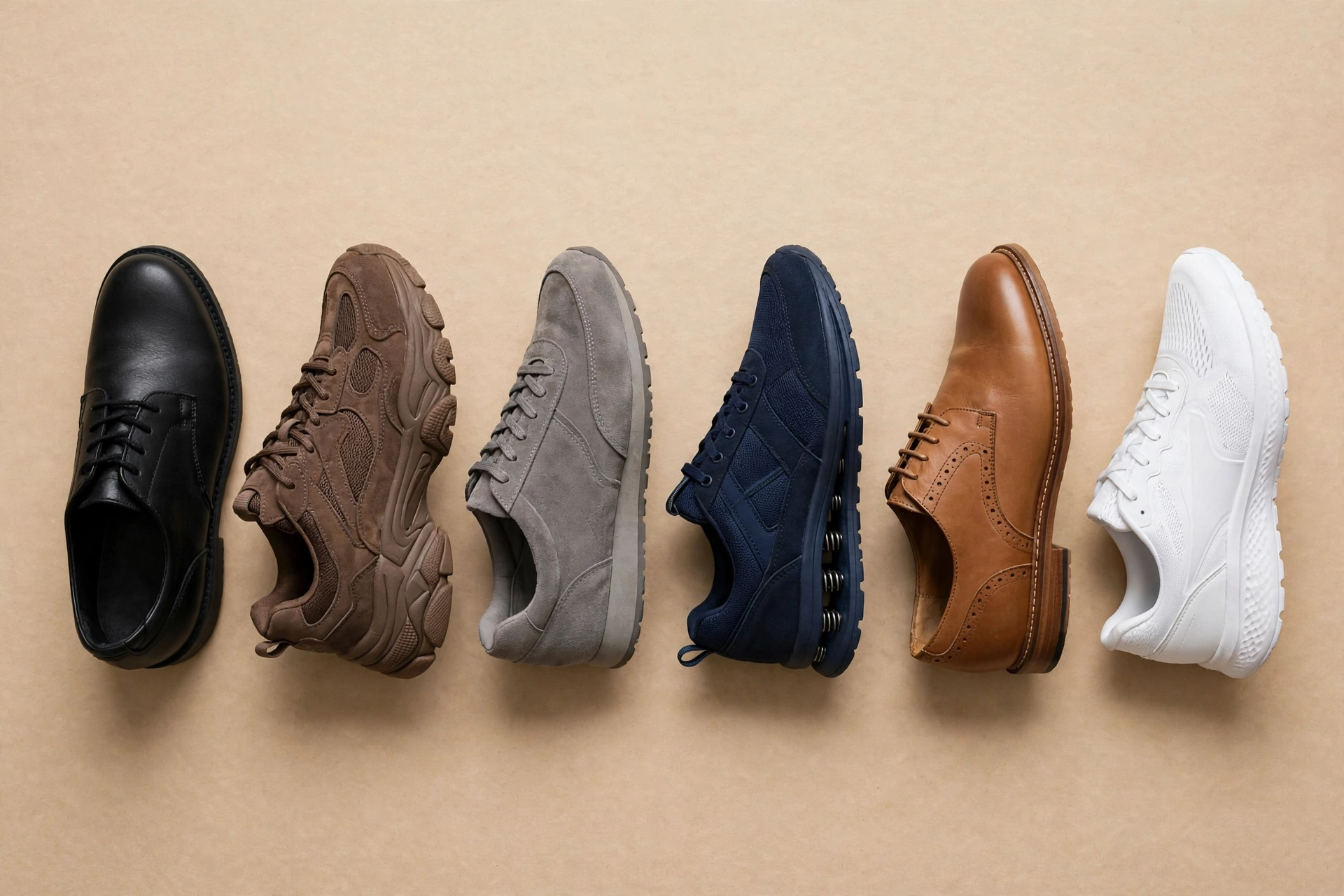
The short answer: if you want maximum cushioning for long hours on hard floors, Gravity Defyer and Z-Coil lead the heritage brands and Hoka’s Bondi 9 leads the modern ones — but the right pick depends on which measure matters most for your day, and the cheapest genuinely comfortable shoe here costs $104, not $300. The table below compares all nine shoes on the same six measures, with current prices checked 25 October 2026. Grades are qualitative — Excellent, Good, or Fair — because no numeric scoring standard exists yet, and a number would pretend at a measurement nobody made.
We may earn a commission if you buy through links on this page, at no extra cost to you. Read our affiliate disclosure.
How this matrix was researched
This is a research comparison, not a hands-on test. Prices come from the brands’ own US stores and major US retailers, checked 25 October 2026. The three heritage brands with full profiles on this site — Gravity Defyer, Z-Coil, and Ecco — are graded from the evidence in those profiles. MBT, Mephisto, and Spira are graded from manufacturer specifications and retailer listings; their full profiles are in preparation and will be linked from the brands hub when published. Hoka, Brooks, and New Balance are included as modern references, graded from published specifications and lab measurements (RunRepeat’s cut-in-half tests among them). Where a claim could not be verified, it was left out rather than estimated.
One note on the old matrix: the original version of this page, on the comfort-shoe site this one rebuilds, priced its six brands at $145–$300. That range no longer holds. Spira starts at $129.99 and Mephisto’s US retail prices now run to $450, so the spread has widened in both directions — which is itself useful information about where the market has gone.
The matrix
| Brand (representative model) | Price (US, Oct 2026) | Cushioning | Support | Widths | Weight | Best use |
|---|---|---|---|---|---|---|
| Gravity Defyer (Mighty Walk) | $104–$155 | Excellent | Good | Excellent | Fair | Standing and walking all day on hard floors |
| Z-Coil (Freedom Classic) | $270–$360 | Excellent | Excellent | Fair | Fair | Maximum heel cushioning for long hours on hard floors |
| Ecco (Soft 7) | $130–$220 | Good | Good | Fair | Good | Smart-casual walking and work |
| MBT (MBT-2000) | $174–$298 | Good | Good | Fair | Fair | Rocker-sole walking |
| Mephisto (Thomas / Match) | $270–$450 | Good | Good | Fair | Fair | Formal leather comfort, dressier settings |
| Spira (Classic Walker) | $130–$140 | Excellent | Good | Good | Good | Budget spring-cushioned walking and standing |
| Hoka (Bondi 9) | $175 | Excellent | Fair | Excellent | Good | Maximum-cushion walking |
| Brooks (Ghost 17) | $150 | Good | Fair | Excellent | Excellent | Everyday all-rounder |
| New Balance (990v6) | $200 | Good | Good | Excellent | Fair | Premium daily wear |
Prices are list prices from each brand’s own US store or major US retailers, checked 25 October 2026. Sale prices run lower — Mephisto’s own US store, for example, lists some styles at about half their list price on sale, and Gravity Defyer’s HybridEx has been seen well below list. Always check the current price before buying.
How to read the matrix
A comparison table is only useful if you know what each column actually measures. The six measures here are not six ways of saying “comfortable” — they solve different problems, and they trade off against each other.
Price: what you pay, and what it buys
Price is the only column with numbers, because prices are published facts. The spread is wide: $104 at the bottom (Gravity Defyer’s slip-on Mighty Walk and Energiya) to $450 at the top (Mephisto’s Marlon). But price does not track comfort in a straight line. Spira’s $129.99 Classic Walker carries spring cushioning in the forefoot and heel plus a memory-foam insert — a mechanism comparable to shoes costing twice as much. What the extra money usually buys is not more cushioning but different things: premium leather and hand-finishing (Mephisto), a visible steel coil and a fitting service (Z-Coil), or American manufacturing (New Balance 990v6). Read price as a budget filter first, then judge the other columns on their own terms.
Cushioning: how the shoe handles impact
Every step is an impact event. Your heel strikes the ground and your body weight has to stop and reverse direction in a fraction of a second. Cushioning is whatever the shoe does with that impact: foam compresses and spreads it out over time, a spring stores it and returns it, a thick stack of foam gives it more distance to dissipate over.
The brands in this matrix answer that question three different ways. Gravity Defyer, Z-Coil, and Spira all use springs — VersoShock polymers, a steel coil, and WaveSpring inserts respectively — and all three earn Excellent here, because a spring does not pack down the way foam does. Hoka’s Bondi 9 earns Excellent the foam way: the tallest stack in the group (43 mm heel) of supercritical EVA, the softest foam Hoka makes. Ecco, MBT, Mephisto, Brooks, and New Balance earn Good: solid, proven cushioning — direct-injected polyurethane, a rocker sole, SOFT-AIR inserts, DNA LOFT v3 foam, FuelCell foam — that handles impact well without being the softest ride available.
One caution: softness is not the same as cushioning that lasts. Foam that feels plush in the shop can pack down over months of daily wear; a spring’s force curve stays the same until the metal fatigues. That is why the spring brands score well here despite very different prices.
Support: what keeps your foot stable
Cushioning without support is a pillow with no frame — comfortable for ten minutes, tiring over ten hours. Support is the structure that keeps the foot aligned while the cushioning does its work: a firm midfoot element, a rigid orthotic, a shaped footbed, or a stable base under a soft stack.
Z-Coil earns the only Excellent here, because its rigid built-in Z-Orthotic is the whole point of the design: the coil handles impact and the orthotic handles stability, as two separate jobs. Gravity Defyer, Ecco, MBT, Mephisto, Spira, and New Balance earn Good — each has a real support mechanism (a lateral stabilizer, an anatomical last, a rocker sole, a contoured footbed, a built-in arch bridge, an ENCAP rim), but none of them is built around support the way Z-Coil is. Hoka’s Bondi 9 and Brooks’ Ghost 17 earn Fair, and that is not a criticism of the shoes — both are deliberately neutral designs with no stability posting. If you want a shoe that actively holds your foot in position, the neutral running shoes are the wrong place to look; if you want maximum softness and your feet are happy staying where they land, Fair support is a fair trade.
Widths: the measure that eliminates the most shoes
Width is the least glamorous column and the one that rules out the most options. A shoe that is too narrow across the forefoot will be uncomfortable no matter how good its cushioning is, and no amount of breaking in fixes a width problem — leather stretches a little, foam does not stretch at all.
The modern brands dominate this column. Brooks’ Ghost 17 comes in narrow, regular, wide, and extra-wide; Hoka’s Bondi 9 in regular, wide, and extra-wide; New Balance’s 990v6 in up to six widths. Gravity Defyer matches them with medium, wide, and extra-wide on its main athletic models. Spira earns Good: wide widths are available on the Classic Walker. Ecco, Mephisto, Z-Coil, and MBT earn Fair — mostly medium-width ranges. Ecco’s answer is its Dual Fit system (removing the insole creates extra room), which helps but is not the same as a dedicated wide size. If you know you need a wide fit, start with the Excellent rows and work down.
Weight: the cost of the cushioning
Weight is the trade-off column. Thick cushioning, springs, steel coils, and leather uppers all add grams, and grams add up over thousands of steps a day. The lightest shoe in the matrix is the Brooks Ghost 17 at about 10.1 oz (men’s 9) — the only Excellent — because it is a mesh running shoe with nothing extra bolted on. Hoka’s Bondi 9 (about 10.9 oz men’s) and Ecco’s Soft 7 (a light, flexible polyurethane sole) earn Good. Everything else earns Fair: Z-Coil’s steel coil and rigid platform, Mephisto’s leather construction (the Will Perf is 12 oz in a size 9), New Balance’s 990v6 (about 13.4 oz), Gravity Defyer’s spring system (the HybridEx is about 11 oz men’s), and MBT’s rocker sole are all heavy by design. None of these weights is a defect — the weight is the mechanism. But if you are on your feet for twelve hours, the difference between 10 oz and 13 oz per foot, repeated ten thousand times, is real.
Which measure matters most: standing all day vs walking
The same shoe can be the right answer for one job and the wrong answer for another, because standing and walking load the foot differently.
Standing all day is a static load. Your feet bear your full weight with almost no movement to pump blood back up the legs, and the pressure sits in the same spots hour after hour. For this job, support and widths matter most, cushioning second, weight least. A soft shoe with no support lets the foot spread and the arch collapse under a static load; a firm, supportive shoe with room across the forefoot holds its shape all shift. That is why Gravity Defyer and Z-Coil — thick cushioning plus a real support structure plus wide fits — sit at the top for standing work, and why a neutral shoe like the Bondi 9, for all its softness, is a weaker standing shoe than its cushioning grade suggests.
Walking all day is a dynamic load. Each step is a cycle of impact, roll, and push-off, and the shoe has to manage that cycle thousands of times. For this job, cushioning and weight matter most, support second. A light shoe with good impact absorption and a smooth heel-to-toe roll — the Brooks Ghost 17, the Hoka Bondi 9, the Spira Classic Walker — keeps the cycle cheap in energy terms. Support still matters, but the foot is moving through its natural range rather than being held in one position, so a neutral shoe is less of a compromise here than it is for standing.
The practical rule: if your day is mostly standing in one place, filter first on support and widths, then on cushioning. If your day is mostly walking, filter first on cushioning and weight, then on support. And whichever job is yours, use the trial period — 60 days for Gravity Defyer, 30 days for Z-Coil — because comfort only shows up after hours on your feet, not in the shop.
The short version, by buyer
- Best value for standing work: Gravity Defyer Mighty Walk slip-on ($104) — Excellent cushioning and widths, Good support, and a 60-day wear test.
- Maximum cushioning, whatever the cost: Z-Coil Freedom Classic ($269.95) — the only Excellent support grade in the matrix, but heavy, unusual-looking, and the most expensive everyday shoe here.
- Best budget spring shoe: Spira Classic Walker ($129.99) — Excellent cushioning at the lowest price in the matrix, with wide widths available.
- Best smart-casual option: Ecco Soft 7 ($160) — the only shoe here that reads as a dress shoe, with Good grades across the board except widths.
- Best modern all-rounder: Brooks Ghost 17 ($150) — the lightest shoe in the matrix, the widest width range, and the cheapest of the three modern references.
- Softest ride: Hoka Bondi 9 ($175) — Excellent cushioning and widths, but neutral support, so better for walking than for standing still.
- Best premium daily shoe: New Balance 990v6 ($200) — Good cushioning and support, up to six widths, but the heaviest of the modern three.
- Best formal comfort shoe: Mephisto Thomas ($289) — premium leather and a contoured footbed, but the priciest range in the matrix and medium widths only.
- Most distinctive mechanism: MBT MBT-2000 ($238) — the rocker sole is a genuinely different answer to the walking cycle, but the range is heavy and mostly medium-width.
What this matrix does not do
Three limits, stated plainly. First, this is a research comparison, not a hands-on test — no one here has worn all nine shoes, and the grades come from specifications, published measurements, and owner reports. Second, the grades are qualitative by design: Excellent, Good, and Fair are judgments, not measurements, and two buyers with different feet can honestly disagree about any of them. Third, comfort is personal in a way a table cannot capture — fit, foot shape, and what your day actually looks like matter more than any grade. Use the matrix to narrow the field to two or three candidates, then use the trial period to decide.
For deeper detail on any brand, read our profiles of Gravity Defyer, Z-Coil, and Ecco, and browse the full set of brands on the brands hub. Profiles of MBT, Mephisto, and Spira are in preparation. If your feet hurt persistently, see a clinician — a shoe is a comfort choice, not a treatment.