The short answer: Ecco is a Danish comfort brand that earns its reputation the hard way — by owning its tanneries and factories and by building most shoes around a direct-injected sole rather than a glued one. If you want a leather walking shoe that looks presentable at work and stays comfortable across a long day on your feet, the Soft 7 at $160 is the default pick. If you need a true wide fit, a heavily cushioned athletic feel, or a sub-$100 price, look elsewhere.
We may earn a commission if you buy through links on this page, at no extra cost to you. Read our affiliate disclosure.
How this profile was researched
This is a research profile, not a hands-on test. Prices and specifications were checked against Ecco’s own US store (us.ecco.com) and major retailers on 25 October 2026, and every price in the table below was confirmed against at least two sources. Owner sentiment comes from buyer reviews published on Ecco’s own store and on independent review sites, plus lab-tested measurements published by Outdoor Gear Lab for the Offroad sandal. Where a claim could not be verified, it was left out. Note one quirk of searching for this brand: most live results for “Ecco shoes review” are about Ecco golf shoes. This profile deliberately focuses on the walking and comfort range instead, because that is the gap no current page fills well.
What Ecco is: a tannery that became a shoe brand
Ecco was founded in 1963 by Karl Toosbuy (with his wife Birte) in Bredebro, a small town in southern Denmark, and it is still family-owned, with its headquarters in Bredebro. The detail that explains almost everything about the brand is its vertical integration: unlike most shoe companies, Ecco owns and runs its own tanneries and much of its own production. By 2000 it owned every step of the process, from leather production and design through to its own retail stores, and it still employs more than 20,000 people worldwide, selling in about 100 countries.
That structure matters for comfort in a practical way. When a brand buys leather from a supplier, it takes what the market offers. When it tans its own leather, it can develop hides for a specific job — soft and pliable for a walking shoe upper, tougher and water-resistant for an outdoor boot — and it can control consistency from batch to batch.
The brand’s positioning has been consistent for six decades: Scandinavian design, premium leather, and comfort technology, aimed at adults who want one shoe to cover walking, work, and everyday life. Most of its walking range lists between about $130 and $220 in the US.
How the comfort tech actually works
Three ideas do most of the work in an Ecco shoe, and they are worth understanding separately because they solve different problems.
FLUIDFORM: the sole is poured, not glued
Most shoes are built in two stages: the sole is moulded separately, then glued or stitched to the upper by hand. Ecco’s FLUIDFORM Direct Comfort Technology skips the second stage. The finished upper is placed in a mould, liquid two-component polyurethane is injected in, and it hardens into the midsole while bonding itself to the upper. One step makes the sole and attaches it.
Three consequences follow from that single change. First, there is no glue line or stitching to fail between upper and sole, which is a common failure point in cemented shoes. Second, the sole can be shaped precisely around the anatomical last — the foot-shaped form the shoe is built on — so the midsole follows the contours of the foot rather than being a flat slab. Third, polyurethane is light and flexible, and unlike the EVA foam used in many sneakers it resists compression set: it keeps its shape and cushioning over more miles instead of packing down. The trade-off is real and worth knowing about (see the owner-reports section below): polyurethane can degrade when a shoe sits unworn in storage for a long time, especially in damp conditions.
BIOM Natural Motion: a last shaped like a foot
BIOM is Ecco’s fit philosophy, used across its walking and golf lines. The last is modelled on the natural shape and movement of the foot, and the sole sits low to the ground. The mechanism is straightforward: a foot that sits closer to the ground has a shorter lever arm on every step, so it rolls more naturally and the shoe needs less built-up structure to keep it stable. The result is a glove-like, low-profile feel rather than the tall, rockered platform of a maximalist walking shoe. Walkers who like ground feel and a natural stride tend to like it; walkers who want a thick stack of foam underfoot tend to find it firm.
ECCO-TEX and GORE-TEX: waterproofing as a membrane, not a coating
Selected Ecco styles are waterproofed with a membrane — either Ecco’s own ECCO-TEX or GORE-TEX on the higher-end models — rather than a surface spray. A membrane is a thin layer inside the shoe that blocks liquid water while letting water vapour out, so feet stay dry from rain without stewing in their own sweat. It adds cost — the waterproof Soft 7 Gore-Tex lists at $180 against $160 for the standard version.
Smaller features fill out the system: a leather-covered inlay sole with the Ecco Comfort Fibre System (ECFS), which wicks moisture away from the foot, and removable insoles on many styles, which allow a little extra width when taken out and let you swap in your own insole.
The current walking and comfort range
Prices are list prices from Ecco’s US store, checked 25 October 2026. Sale prices run lower and vary by colour and size — the Soft 7, for example, is frequently listed around $125 on sale.
| Model | Best for | List price (US) |
|---|---|---|
| Soft 7 (leather or nubuck sneaker) | Everyday walking, smart-casual work | $160 |
| Soft 7 Gore-Tex sneaker | Wet-weather walking | $180 |
| Soft 7 Tred (Gore-Tex boot) | Cold and wet conditions | $200–$220 |
| BIOM 2.2 (textile sneaker) | Active walking, lighter feel | $160 |
| BIOM 2.2 BOA | Same, with dial closure | about $180 |
| Helsinki 2 (slip-in derby) | Dressier work settings | $175 |
| Offroad hiking sneaker | Trails and rough ground | $175 |
| Offroad Yucatan sandal | Warm-weather walking, travel | about $140 |
| Soft Sandal (two-strap) | Summer, easy on and off | $130 |
| S-Lite Moc (moccasin) | Slip-on everyday wear | about $140 |
Soft 7: the default Ecco
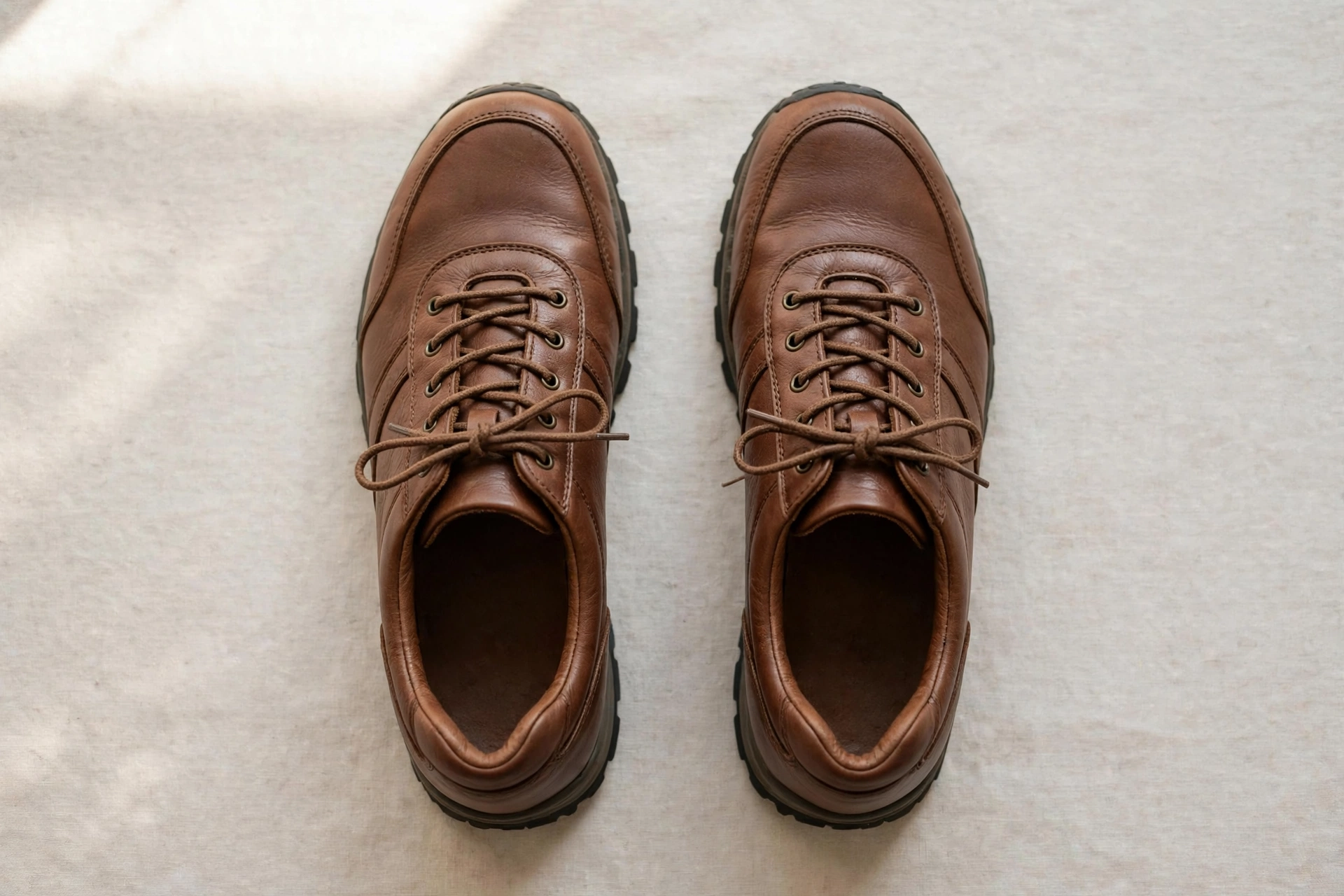
The Soft 7 is Ecco’s bestseller and the right starting point for most buyers. It is a clean leather sneaker — lace-up, slip-in, and zip-bootie versions — with a dimpled polyurethane and TPU outsole for grip, a long-lace system for adjusting fit, and the standard FLUIDFORM sole. Owner reports on Ecco’s own store run to hundreds of ratings for the men’s leather version, and the recurring theme is straight-out-of-the-box comfort with no break-in period. Its weakness is also its identity: it is a leather sneaker, not an athletic shoe, so it will not feel as soft or as light as a foam running shoe. The women’s Gore-Tex version at $180 is the pick if you walk in rain; the Tred boots at $200–$220 add a mid-cut waterproof build for winter.
BIOM 2.2: the sportier option
The BIOM 2.2 is a textile lifestyle sneaker built on the BIOM last, with Ecco’s LYTR technology — a lighter version of its anatomical fit system — plus a padded heel collar and rubber grip inserts. It lists at $160, the same as the Soft 7, and the BOA dial-closure version runs about $180.
Offroad and Yucatan: sandals and trail shoes
The Offroad line descends from the Yucatan sandal, which Ecco says changed its outdoor range when it launched about twenty years ago. The Yucatan is a three-strap leather walking sandal with a contoured EVA footbed and a durable rubber outsole, listing at about $140 (retailers show $140–$150). Outdoor Gear Lab’s lab test named the Offroad sandal a favourite for casual comfort, praising its consistent performance and high-end comfort, while noting it is a casual sandal rather than a technical hiker. One consistent owner and reviewer note: the Yucatan runs narrow, and suits slender feet better than wide ones.
Helsinki 2 and S-Lite Moc: the dressier end
The Helsinki 2 is a leather slip-in derby at $175 — the Ecco to buy if your workplace expects something smarter than a sneaker but you still want the FLUIDFORM sole underneath. The S-Lite Moc is a leather moccasin at about $140, with a removable leather insole that gives extra width when taken out. Both are better thought of as comfortable dress shoes than as walking shoes.
Fit and widths: the honest picture
Ecco fits on the narrower side of medium, with an anatomical last that hugs the midfoot. That is a feature for people with narrow to medium feet and a problem for people with wide feet. Ecco does not sell most styles in dedicated wide widths. Its answer is the Dual Fit system on selected styles: removing the insole creates extra room in the toe box, giving a wider fit without a separate width size. Many other styles have a removable insole that can be taken out for a little more space, or swapped for a thinner one.
Practical advice from owner reports: order your usual size first, and use a retailer with free returns. If you are between sizes, or you know you need a genuinely wide fit, Ecco’s Dual Fit workaround may not be enough — and that is a real reason to look at a brand that sells proper wide widths instead. For more on the wide-fit question, see our guide to the best shoes for flat feet.
Who Ecco suits — and who should skip it
Ecco suits you if:
- You walk a lot and want one leather shoe that works for walking, errands, and smart-casual work.
- You value premium materials and construction — full-grain leather from the brand’s own tanneries, a sole bonded rather than glued.
- You like a low, natural feel underfoot rather than a tall cushioned platform.
- You have narrow to medium feet and are happy with a snug anatomical fit.
- You walk in wet weather and want a genuinely waterproof leather option (the Gore-Tex versions).
For people who spend full shifts on their feet, the Soft 7 is also a credible option for work — see our guide to the best shoes for teachers standing all day.
Skip Ecco if:
- You need a true wide width — the Dual Fit insole trick helps, but it is not the same as a wide size.
- You want maximum cushioning or a soft, bouncy athletic feel — the BIOM platform is deliberately firm and low.
- Your budget is under $100 — Ecco rarely goes there, even on sale.
- You want a shoe for running or gym training — this is a walking and everyday brand.
- You plan to buy a pair and leave it in a cupboard for a year before wearing it (see below).
What owner reports say — including the weak spot
The broad pattern in owner reports is consistent: comfortable from the first wear, durable uppers, and leather that ages well. The Soft 7’s hundreds of owner ratings on Ecco’s US store skew positive on comfort and quality, and independent reviewers of the Offroad sandal praise its comfort and build.
There is one recurring complaint worth taking seriously, because it follows directly from the construction described above. A long thread of owner reports on review aggregators describes Ecco soles crumbling, cracking, or turning gummy on pairs that were stored unworn for months or years — sometimes on shoes with very little wear. The mechanism is polyurethane hydrolysis: the same PU that makes FLUIDFORM soles light and durable in use can break down when exposed to moisture and time without being worn. It is not a defect in a single model; it is a property of the material, and it affects shoes from several brands that use PU soles. The practical lesson is simple: buy Ecco shoes to wear them, wear them regularly, and store them somewhere dry. Do not stockpile a spare pair for next year.
Ecco vs Clarks
Clarks is the comparison most buyers actually make, and the two brands solve comfort from opposite directions. Ecco is the premium leather option: its own tanneries, direct-injected soles, and a $130–$220 walking range. Clarks is the high-street comfort option: its Cloudsteppers line, built around a soft EVA footbed, typically sells for about $77 to $98, and Clarks offers wide widths in many styles — something Ecco does not.
Choose Ecco if you want better leather, a dressier look, and a sole that holds its shape over more miles. Choose Clarks if budget matters, if you need a wide fit, or if you prefer a softer, more cushioned first step. The price gap between comparable styles runs roughly $60–$80, and you are paying it for materials and construction rather than for comfort alone.
Ecco vs Mephisto
Mephisto is the other European comfort brand in this price bracket, and the comparison is mostly about money and formality. Mephisto sits a clear step above Ecco on price: its men’s waterproof styles list at £265–£300 on Mephisto’s UK store, against Ecco’s $130–$220 range. Mephisto’s range leans more formal and handcrafted, with a narrower focus on classic leather styles, while Ecco covers more ground — sneakers, sandals, outdoor shoes, and golf alongside its dress styles.
Choose Ecco if you want the broader range, the sportier options, and the lower price. Choose Mephisto if you want a more traditional, formal comfort shoe and are comfortable paying for it. As with Clarks, no direct comparison article currently exists for this pairing — the search results are retailer listings and a travel forum thread — so buyers are left to piece it together themselves.
The bottom line
Ecco is a straightforward proposition once you see past the golf-dominated search results: a family-owned Danish brand that tans its own leather and pours its own soles, selling well-made leather walking shoes at $130–$220. The Soft 7 is the right first pair for most people, the BIOM 2.2 is the sportier alternative, and the Yucatan sandal covers warm weather. The two things to get right are fit — narrow to medium, try before you buy — and storage: wear them, do not warehouse them. Get those right and an Ecco is a durable, comfortable daily shoe. For the rest of the brand landscape, browse the full brands hub, including our profiles of Gravity Defyer and Z-Coil.