The short answer: the best shoes for chefs are the Hoka Bondi SR for maximum cushioning, the KEEN Utility PTC Oxford for a classic leather work shoe, and the Crocs Bistro Pro LiteRide for a tight budget. Every pick below has a slip-resistant outsole tested for wet or oily floors, a closed toe, and an upper that handles spills. What separates them is cushioning, durability, and price, and the right one depends on how many hours you stand and what your kitchen floor throws at you.
We may earn a commission if you buy through links on this page, at no extra cost to you. Read our affiliate disclosure.
How we chose these shoes
This is research-desk work, not a wear test. We checked current models and prices against brand pages, retailer listings, and owner-review patterns in October 2026, and we only kept shoes whose slip resistance is backed by a named test standard or a long record of kitchen use. Prices are US list or typical street prices at the time of writing and vary by size, color, and retailer, so treat them as a guide and check the current price before buying. A shoe was cut if we could not verify its current model or price from at least two sources.
Our parent hub for kitchen and other work footwear is /work-shoes/. If your shifts run long, our guide to the best shoes for 12-hour shifts covers the cushioning question in more depth.
Why a kitchen floor defeats ordinary shoes
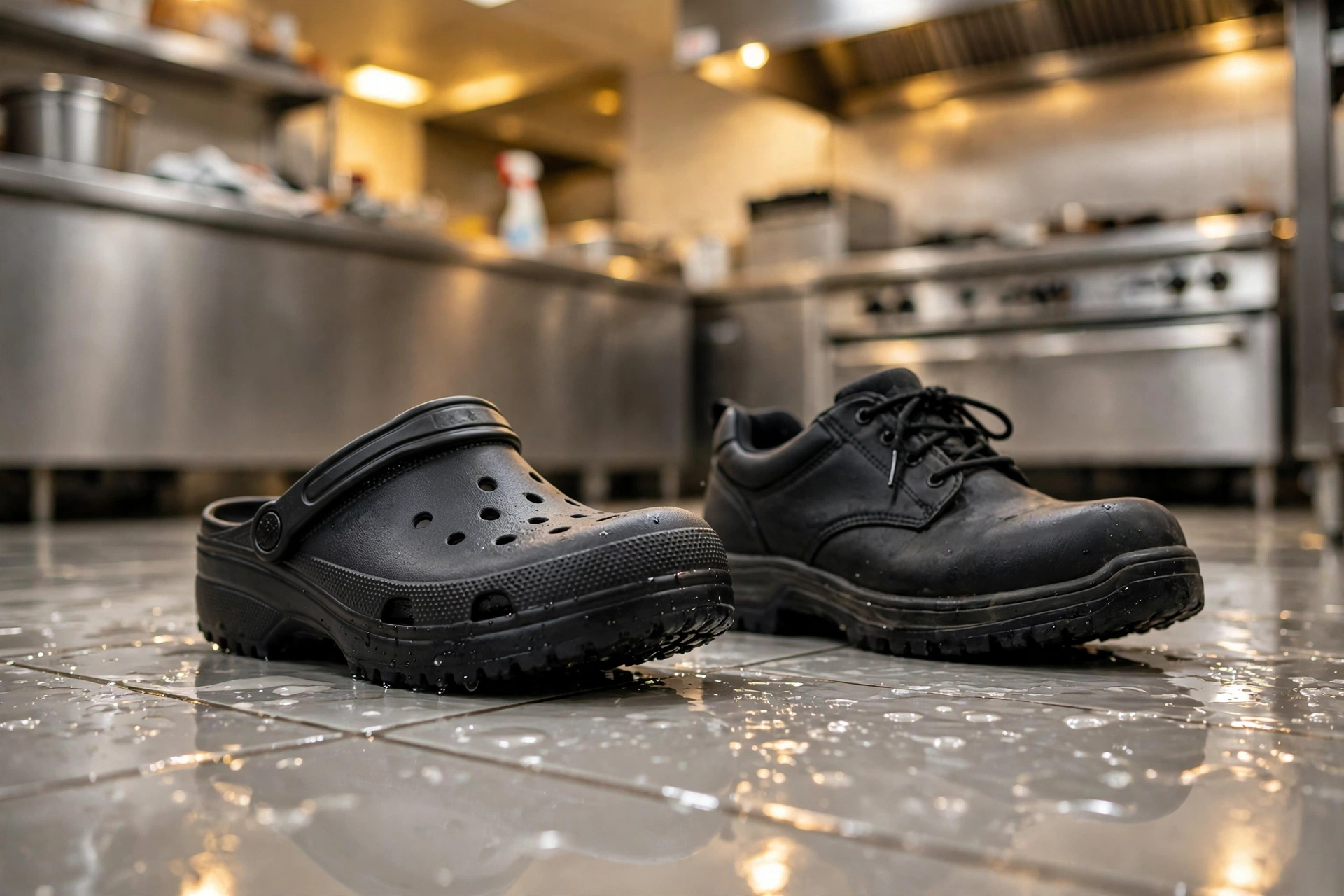
A kitchen floor is a friction problem before it is a comfort problem. Grip comes from rubber meeting floor, and two things get in the way: water and grease. A thin film of either turns a smooth tile into a surface with almost no friction, and the tread pattern decides whether that film stays under your foot or gets pushed aside.
That is the whole mechanism behind a slip-resistant outsole. The tread has channels that give liquid somewhere to go, so rubber can make contact with the floor instead of hydroplaning on a film of water or oil. Softer rubber compounds help too, because they deform slightly into the tiny texture of the tile and grip more surface. This is why a deep-lugged, soft-rubber outsole outperforms a flat, hard one on a wet floor, and why tread wears matters: once the channels shallow out, the liquid has nowhere to go and grip falls away.
Grease makes it worse than water alone. Cooking oil coats the floor and the tread, and it does not evaporate the way water does. That is why the better kitchen shoes pair a channelled tread with a rubber compound rated for oil exposure, and why rinsing the tread matters as much as buying the right shoe.
Then there is the shift itself. A chef stands and walks on hard tile for 10 hours or more, which loads the same small contact points in the foot thousands of times. Cushioning spreads that load: a thick, soft midsole absorbs the impact of each step instead of passing it straight to the heel and forefoot. Support is the other half. A shoe with a firm heel cup and a structured midsole keeps the foot from rolling inward as the muscles tire late in a shift, which is when most of the aching sets in. Neither feature replaces the other, which is why the best kitchen shoes have both.
Finally, a kitchen is hot, wet, and sharp. Spills land on your feet, knives and heavy pans fall, and the air near the line can be punishing. A closed toe is non-negotiable, a water-resistant upper that wipes clean saves you from soggy socks by hour three, and a slip-on or laceless design means you can kick the shoes off the moment service ends. Breathability trades directly against water resistance: a leather upper keeps spills out and holds heat in, while a ventilated clog breathes and lets liquid in through the vents.
The best shoes for chefs at a glance
| Shoe | Price | Best for | Slip resistance | Upper |
|---|---|---|---|---|
| Hoka Bondi SR | about $180 | Maximum cushioning | Slip-resistant work outsole | Water-resistant leather |
| KEEN Utility PTC Oxford | about $150 | Classic leather work shoe | ASTM F1677 Mark II, ASTM F3445 | Water-resistant leather |
| Dansko Professional | about $150 | All-day clog support | Slip-resistant PU outsole | Leather, wipeable |
| Birkenstock Tokio Super Grip | about $160 | Structured footbed, heel strap | Grease-resistant Super Grip sole | Leather |
| New Balance 626v2 | about $85 | Wide feet, sneaker feel | Slip-resistant outsole | Leather |
| Skechers Work Bronwood SR | about $100 | Slip-on value | ASTM F1677 Mark II tested | Water-repellent leather |
| Crocs Bistro Pro LiteRide | about $60 | Budget clog with better cushioning | Crocs Lock slip-resistant tread | Croslite, rinse clean |
| Crocs Bistro | about $45 | Cheapest proven kitchen shoe | Crocs Lock slip-resistant tread | Croslite, rinse clean |
Hoka Bondi SR: best overall cushioning
Price: about $180
The Bondi SR is a maximum-cushion running shoe rebuilt as a work shoe, and that is exactly what makes it the pick for chefs who finish every shift with tired feet. The thick EVA midsole is the softest in this roundup by a clear margin, and the water-resistant full-grain leather upper wipes clean with a damp cloth, which matters when stock or sauce goes over your shoes instead of into the pot.
The outsole is a slip-resistant rubber built for wet and oily floors, and the shoe carries the APMA Seal of Acceptance. It comes in regular and wide widths, which is useful when feet swell over a long shift. Owner reports consistently praise the cushioning and the grip, and consistently complain about two things: the leather upper runs warm in a hot kitchen, and the tall, chunky sole takes a few shifts to get used to on stairs.
Buy it if cushioning is your first priority and your budget stretches to it. If you work a station where you rarely leave the line, this is the most forgiving shoe on the list.
KEEN Utility PTC Oxford: best leather work shoe
Price: about $150
The PTC Oxford is the most kitchen-specific lace-up in this roundup. The full-grain, water-resistant leather upper shrugs off spills, the removable KEEN.Cush footbed combines PU and memory foam, and the compression-molded EVA midsole gives it a firmer, more traditional feel than the Hoka. A TPU shank runs through the midfoot for stability, and the shoe is electrical-hazard rated.
The slip-resistance credentials are the strongest documented here: the outsole meets ASTM F1677-96 Mark II non-slip testing and ASTM F3445-21, and the outsole and midsole meet ASTM oil-resistance standards. Owner reports say the shoe runs slightly large, so try a half size down, and that it feels firmer than a sneaker-style shoe for the first week. It is a substantial, professional-looking shoe that passes stricter dress codes than a clog.
Dansko Professional: best clog for long shifts
Price: about $150
The Dansko Professional is the clog that defined the category, and it is still the benchmark for structured support in a slip-on. The leather upper wipes clean, the roomy toe box lets toes spread, and the rocker-bottom sole rolls the foot forward with each step instead of forcing the foot to bend. The footbed is removable, so it accepts a custom insole.
Owner reports say the break-in takes a few shifts, the heel is higher than a flat shoe, and the rigid sole feels odd until the rocker motion clicks. Once it does, the shoe is famously durable: many owners report a year or more of daily wear.
Buy it if you like clogs and want structured support rather than soft foam. Pair it with the right socks and give it a week before judging it.
Birkenstock Tokio Super Grip: best structured footbed
Price: about $160
The Tokio Super Grip is the Birkenstock Professional clog with two kitchen-specific upgrades: a grease-resistant Super Grip rubber sole and an adjustable heel strap that keeps the clog on your foot when you move fast. Underneath sits the contoured cork-latex footbed with a deep heel cup and arch support that molds to the wearer over time, which is the feature owners praise most once the footbed breaks in.
The trade-offs are familiar to anyone who has worn Birkenstocks. The footbed needs a break-in period, the leather upper needs more care than a rinse-clean clog, and the list price is near the top of this roundup, though street prices often run lower. Sizes run from 35 to 48, and the strap makes it more secure than an open-back clog for fast line work.
New Balance 626v2: best for wide feet
Price: about $85
The 626v2 is a leather work sneaker that looks like a regular trainer and behaves like a work shoe. The slip-resistant outsole handles wet tile, the leather upper wipes clean, and the ABZORB cushioning is firmer than the Hoka but comfortable for a full shift. Its real advantage is fit: it comes in a wide range of widths, including extra-wide, which is rare at this price.
Owner reports say the sizing is generous and the shoe is a good middle ground between a clog and a heavy leather oxford. The cushioning is adequate rather than generous, so if maximum softness is what you need, the Bondi SR is the better pick. But for the price, and for chefs who struggle to find wide work shoes, the 626v2 is hard to beat.
Skechers Work Flex Advantage SR Bronwood: best slip-on value
Price: about $100
The Bronwood is a slip-on leather loafer-style work shoe with twin elastic side panels, so it goes on and off without laces and without bending down. The Relaxed Fit design gives the toes room, the memory foam insole cushions well for the price, and the upper is water- and stain-repellent leather. The outsole is slip-resistant and tested to ASTM F1677-05 Mark II, and the shoe is electrical-hazard rated.
Street prices vary widely by retailer and size, from under $100 to about $125, so shop around. Owner reports praise the easy on-off and the roomy fit, and note that the slip-on design means less heel hold than a lace-up when you are moving fast. The built-in 1 1/4-inch heel is worth knowing about if you prefer a flat shoe.
Crocs Bistro Pro LiteRide: best budget clog
Price: about $60
The Bistro Pro LiteRide takes the standard Bistro clog and adds a LiteRide foam insole and an adjustable heel strap, which together fix the two most common complaints about the base model: thin cushioning and a loose heel. The Croslite construction is fully enclosed, slip-resistant with Crocs Lock tread, and rinses clean under a tap, which is the whole point of a kitchen clog.
At about $60 list, it is the cheapest shoe here with a real cushioning upgrade. Owner reports say it runs large and recommend sizing down, and that the foam insole wears faster than the shoe itself, so expect to replace the insole before the clog. It is light, cheap, and easy to clean, which is why it shows up on so many line cooks.
Crocs Bistro: cheapest proven kitchen shoe
Price: about $45
The standard Bistro is the workhorse: enclosed toe, Crocs Lock slip-resistant tread, one-piece Croslite construction that hoses clean, and a price that makes it easy to keep a spare pair. The Amazon listing carries tens of thousands of owner reviews at about 4.5 stars, which is a larger base of kitchen experience than any other shoe here.
What you give up against the Pro LiteRide is cushioning and the heel strap. The standard footbed is thinner, and the fit is looser, so it suits shorter shifts and cooks who change shoes often. For a first kitchen job or a backup pair, it is the lowest-risk buy on the list.
What to avoid in a chef shoe
- Mesh running shoes. Mesh uppers soak up spills and hold heat and moisture against the foot. A kitchen shoe needs a wipe-clean, water-resistant upper.
- Open-back clogs without a strap. A clog that flies off when you pivot is a hazard to you and to everyone carrying hot food near you. If you want a clog, get an enclosed heel or an adjustable strap.
- Smooth, flat soles. A flat sole has nowhere for water and grease to go. Look for deep channels and lugs in the tread, and check them monthly for wear.
- Shoes with no documented slip testing. “Non-slip” on a product page is a marketing word, not a standard. Prefer shoes that name their test, such as ASTM F3445, ASTM F2913, or the Mark II test.
- Wearing kitchen shoes outside. Concrete, gravel, and pavement chew through soft rubber tread far faster than tile does. Keep a separate pair for the commute and your kitchen shoes will grip longer.
How to pick your pair
Start with your employer’s rules. If your kitchen requires a named test standard, that narrows the list to the KEEN PTC Oxford and the Skechers Bronwood, with the Hoka Bondi SR and the Crocs models as backups if their certification is accepted. If there is no policy, start with fit and cushioning.
Try shoes on at the end of a shift, when your feet are at their largest, and wear the socks you work in. A shoe that fits in the morning can pinch by hour eight. Walk on a hard floor, not carpet, and pivot sharply: a shoe that grips in a straight line but slides on a turn is telling you something. If you stand mostly in one place, cushioning matters more than weight; if you move constantly between stations, a lighter shoe with a secure heel matters more. If your station is a concrete floor rather than tile, our guide to the best shoes for standing on concrete all day covers that surface specifically.
Buy two pairs if you can. Rotating pairs lets each one dry out fully between shifts, which extends the life of the cushioning and keeps the uppers from staying damp. It also means you are never forced to wear a pair whose tread is worn smooth because the spare is still in the box. Warehouse work has different demands again, and if you split time between the kitchen and the stockroom, our best shoes for warehouse workers roundup covers that side.
Prices and availability were checked in October 2026. Models and prices change, so confirm the current price and the slip-resistance specification on the retailer’s page before buying.